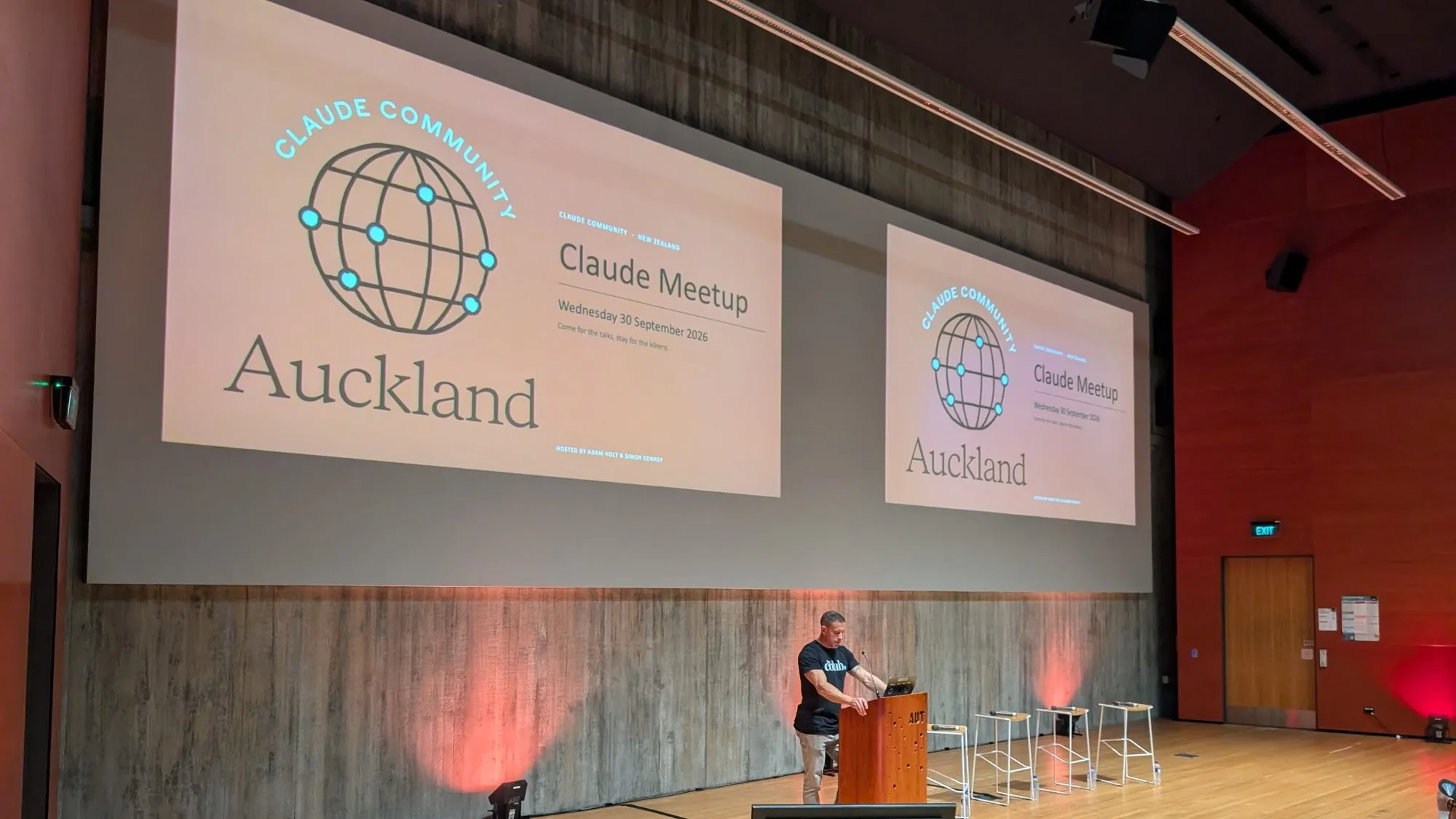
Notes and takeaways from the Claude Meetup Aotearoa
Notes from the Auckland Claude meetup: AI adoption at airline scale, governance as an accelerator, agents as teammates, and who the future gets built for. With commentary from the ElementX crew.

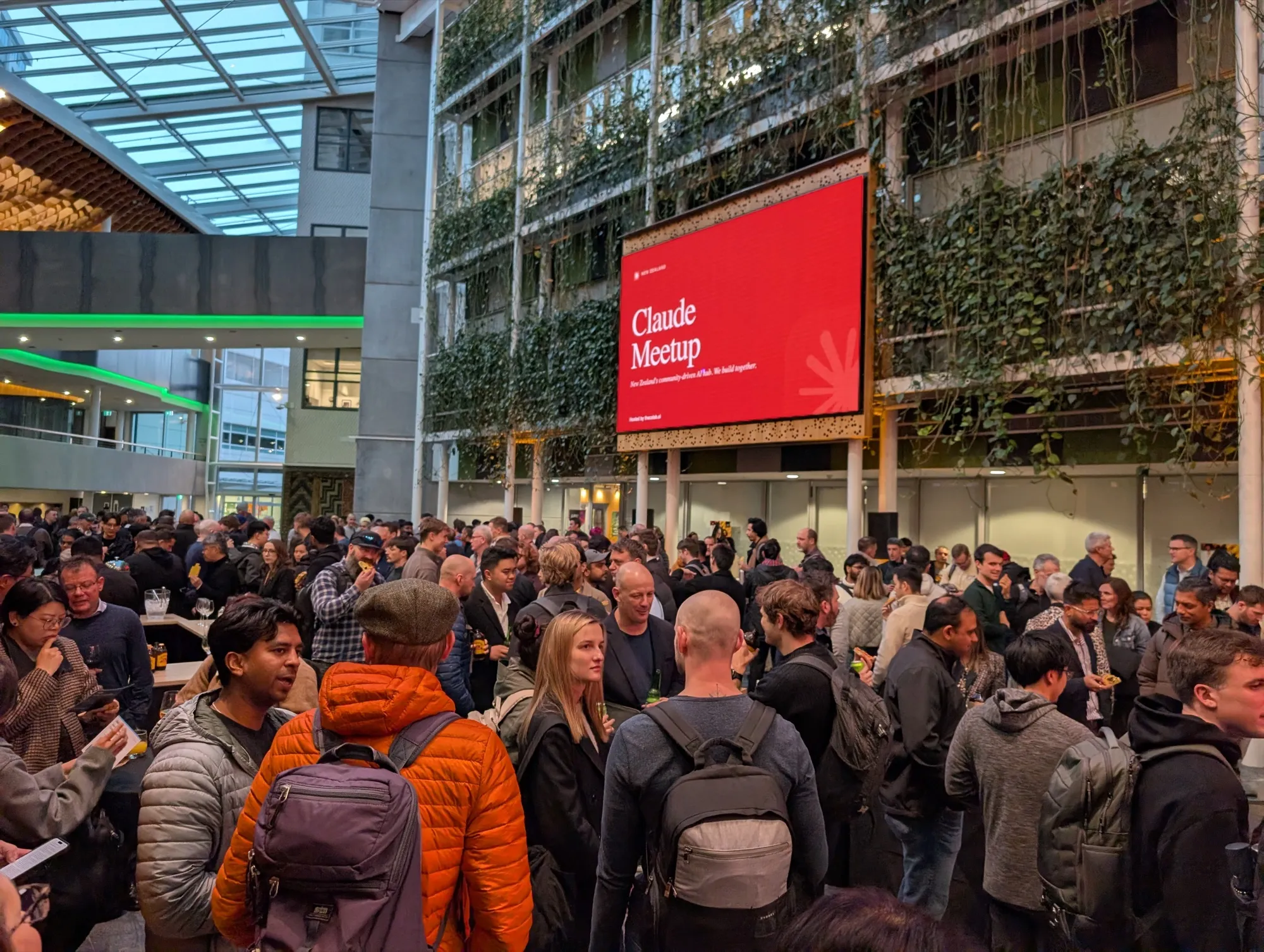
If you couldn’t make the July Claude meetup in Auckland, or you were there and want the takeaways in one place, these notes are for you. Four talks and a panel covered the full arc of where enterprise AI is landing right now: rolling AI out across an entire airline, turning a two-week legal bottleneck into a two-minute self-serve workflow, agents starting to work as colleagues rather than tools, and a historian’s view of who this technology will serve. Simon Conroy kept the evening on the rails as MC.
We’ve kept the notes faithful to what each speaker said, and added our own commentary throughout; look for the “Our take” blocks.
Mike Parsons: rolling AI out to an entire airline
Mike leads enterprise AI adoption within Air New Zealand’s digital organisation, where he has taken AI tooling from early proofs of concept to more than 3,000 licensed users, all under the governance demands of government-owned, nationally critical infrastructure. Outside of work he’s a published science-fiction novelist (six of them), a former Canadian junior chess champion, and currently building a chess-career simulation game called Ultimate Grandmaster.
- Capability beats integrations. His staff chose OpenAI Codex over Copilot, despite Copilot’s deep Microsoft 365 integrations. Counterintuitive, but raw model capability won out over integration breadth.
- AI belongs to everyone. Rather than rationing licences by department (“are we the guys in the ’90s deciding who gets email?”), they rolled it out to all knowledge workers. Learning loops should be fast and distributed across the organisation, not concentrated in one team. And be transparent about what you try and what you learn.
- Governance is the enabler, not the blocker. Air New Zealand is government-owned, nationally critical infrastructure and, in Mike’s words, “the safest airline in the world”, so governance rests on four legs: privacy, legal, cybersecurity and data science. That last one covers algorithmic bias, which matters acutely in multicultural New Zealand, especially in areas like recruitment. Build safe guardrails, then say “go for it”.
- A permissive, celebratory culture. Never shame AI use; celebrate “that used to take twelve hours and took you two”. Weekly “what did you do with AI this week?” sessions draw around 1,000 followers, and they’re deliberately fronted by non-technical people from finance or maintenance so AI isn’t seen as owned by digital.
- Real adoption versus passive resistance. Usage sits around 85%, but resisters don’t refuse; they log one trivial query a week (“what time was the All Blacks game?”) so the metrics look fine while output stays low. The metric that matters is how fast you move someone from “this costs me time” to “this saves me time”.
- The fastest way to convert a sceptic is a story from their own world. Aircraft parts go by different names across suppliers, and the global supply chain is in rough shape, so Air New Zealand’s supply chain team would routinely lose hours chasing a single part. One of them tried AI instead and found the part in five minutes; when teammates asked why they looked so pleased with themselves, the disbelief (“it always takes hours and hours”) converted the whole team overnight, because the example spoke their language. Mike says moving someone from “this will cost me time” to “this will save me time” used to take him half an hour of persuasion; with the right story it now takes under five minutes. And once people are in credit on time, encourage them to reinvest it in learning more; every workflow you solve keeps paying you back.
- Reframe risk for risk-averse organisations. Aviation already assumes humans make mistakes and builds compensating controls; identifying risk is supposed to be these teams’ superpower. Ask “where is it appropriate, and with what controls?” instead of saying no. His personal version: a burner laptop with a $500-limit card for trying dodgy AI services. Contain the blast radius.
- The three-layer cake. AI for individuals gets near-total freedom: duplication is fine, the cost is low and the learning is high. Big rocks get significant effort and stronger governance. Agents sit at “cautious curiosity”: sandboxing, permissioning, and the open question of agent identity. An agent inheriting a person’s permissions and going rogue “can’t happen”.
- Tokenomics: four control levers. Per-person token limits (easiest, but blunt: the best users are defined by mindset, not role). Workload routing (attractive in theory, hard and invisible in practice, though probably where things are heading). Building a harness (his strong recommendation: “same quality at 50% of the tokens”, or his medium-reasoning harness that approximates extra-high). And model choice (policy alone fails; it’s an education problem, and people leave everything on the highest settings).
Natalie Kim: NDA review, from two weeks to two minutes
Natalie is the founder of Inflection Group, an AI strategy and governance advisory, and a strategic advisor to Anthropic who helped build Claude for Legal. A Harvard Law JD, she spent eighteen years in the US building a career across tech and legal in the Bay Area and Seattle, most recently as general counsel at a venture-backed cleantech company, where she also led company-wide AI transformation alongside the CEO. She’s now returned home to New Zealand after what she calls “the world’s longest OE”.
“AI transformation cannot stop at doing the existing work faster; it needs to reimagine the work.”
- Everyone feels behind, even the Bay Area. Her worked example: taking NDA review turnaround from two weeks to two minutes.
- The problem: a templatised document stuck behind a human bottleneck. NDAs are about as standard as legal agreements get, yet everyone insists on their own editorial tweaks (“lawyers are very attached to their own specific words”), so each one still gets reviewed manually by a lawyer, who usually has twelve fires to fight before reaching your NDA. Fires don’t wait in line. At her company, where she was solo counsel, that meant two-week turnarounds for what is mostly boilerplate. Her fix came in three versions.
- V1, the generic prompt, looks impressive and is “completely useless”. It knows nothing about your company, context or risk posture, and ten runs give ten different answers. People who stop here wrongly conclude AI isn’t ready. That’s using AI, not building with AI.
- V2, a customised skill, encoding sixteen parameters of how she thinks about NDA risk, cut her personal review from twenty minutes to two. But turnaround stayed at two weeks, because only she could run it. Speeding up the bottleneck isn’t transformation.
- V3: governance is the accelerator. People hesitate to delegate to AI because they don’t trust it; governance is how trust gets built (even if she had to rebrand her committee “AI Innovation and Oversight” to keep the board awake). Her skill-design pillars: identity (what you are, and what you’re never allowed to pretend to be), hard stops (explicitly scope what it must never do, so chained agents don’t trample each other), sign-off thresholds (what sails through versus what needs a human), and graceful degradation (when it’s out of its depth, hand off with context so the human doesn’t start from scratch).
- The result: sales self-serves, negotiating and signing their own NDAs, with output written for a salesperson audience and legal pulled in only when it’s needed. The pattern replicated across legal, marketing and finance.
- You don’t need to be technical. “If you can use a Word document, you can use a markdown file.” What you do need: the ins and outs of your company and its culture, plus the subject-matter experts closest to the workflow. It’s unglamorous process-improvement work; the alternative “looks like it works” while quietly accruing governance debt.
- Make space for the slowdown before the leap. Her skill took four hours to build but two weeks of monitored piloting. Leaders must give teams room to change how they work on top of their existing workload, and individual contributors shouldn’t make their acceleration “somebody else’s problem tomorrow”.
Adam Holt and Jake McInteer: agents joining the team
Adam is New Zealand’s Claude Ambassador, a serial builder across several businesses, and the driving force behind the local Claude community and the CoLab group; he hasn’t written a line of code by hand in eight months, and recently returned from the developer conference in Tokyo even more bullish. Jake joined Anthropic in Sydney roughly seven weeks before the meetup, after a stint at MongoDB where he ran the developer meetups that first put Adam on stage. The two have spent months experimenting with multi-agent collaboration, including their WhatsApp agents “Kev” (a shark) and “Keith” (a goose).
“Don’t build for the model you’ve got today; build for the model that’s going to be there in six months.”
- Capability is compounding faster than org charts can adapt. And the progress chart is logarithmic, which makes it scarier than it looks. There’s no sign of it slowing down: Fable 5 and Mythos 5 landed while the slides were being written.
- Don’t take a point-in-time view of AI (Jake). When AI fails at something today, stash the failure; it’s the perfect test case for the next model release. Look at the direction of the line, not the current dot.
- The Bun rewrite story. Bun creator Jarred Sumner rebuilt what he estimated as a full team-year of work in eleven days, solo, using new workflow features. Jake is lukewarm on the “SaaS apocalypse”: the cost of producing software is trending toward zero, but the cost of maintaining it isn’t. Don’t rebuild everything; do rebuild the third-party software that’s a binding constraint on your business.
- Agents as colleagues. Their two WhatsApp agents collaborated like two people, spinning up databases and building a web app in a Sunday afternoon: a preview of agents as entities within organisations. The corollary: treat agents like junior hires. Give them their own identity and permissions, and don’t hand them the company credit card.
- Goals and loops. Long-running agents (13 to 24+ hours) work when there’s a clear objective and a way to self-test, like a browser or a verifiable outcome. Long runtime doesn’t guarantee good output: models want to please you, so build verification in rather than trusting the answer.
- Tokenomics as capex, not opex. Discovering a new AI workflow carries an upfront, deliberately wasteful cost; you then hill-climb on efficiency while model prices fall for a given level of intelligence.
- Claude Tag is the headline. Claude as a multiplayer teammate in Slack, with its own account, per-channel permissions, and memory that respects channel boundaries. It now opens 65% of Anthropic’s pull requests, and context accumulates naturally in channel history, which dissolves much of the context-maintenance and hallucination problem of hand-built harnesses. Teams support is coming.
- Build dexterity, not just tool skills. Claude Code went from 0% to 100% of how Anthropic writes code, and its share is already declining as newer tools arrive. Enablement on any single tool is half the equation; the durable skill is comfort with constant change.
- Do more of your work in the open. Day-to-day work that lives in DMs is invisible: to your colleagues, and to any agent you’d like to help out. Move it into open Slack or Teams channels and the context accumulates where an agent can absorb it and start contributing proactively, and where the knowledge compounds for the humans too. Jake likened the shift to Bezos’s early-2000s mandate that every Amazon team expose its work through clean interfaces: an unglamorous discipline at the time, and the one that made AWS possible.
Damon Salesa: who does the future get built for
Professor Damon Salesa is Vice-Chancellor of Auckland University of Technology (28,000 students and 4,000 staff) and a distinguished scholar of social and technological change and of the Pacific. He leads one of the institutions most directly exposed to AI’s disruption of education, and brought a historian’s lens to the question of who technological revolutions really serve.
“Technology is neither good nor bad; nor is it neutral.”
- Kranzberg’s first law. Technology always interacts with its social, political and economic context: the printing press spread both the Reformation and the Inquisition; the internet connected the world and surveilled it. The same technology liberates in one context and imprisons in another.
- Artifacts have politics. Design encodes who will use a technology and on what terms, like who gets the power station next door and who gets the high-voltage line overhead. A system built without your participation will often work against you, not through malice but through indifference, which is just as consequential.
- The enduring questions are never just what a technology can do, but who it will do it for, on what terms, who decides, and who benefits.
- AI is historically unusual. It’s the first major technological shift without public-research origins; it came from the commercial private sector. That’s part of why Anthropic’s constitutional AI and safety commitments drew him in: an inspiring intellectual project, building a constitution for a technology we haven’t yet seen.
- AUT started with principles, not technology. Affirming te tāngata, the primacy of human-to-human relationships (dismissed as too obvious to write down two years ago; prescient now that people form deep relationships with AIs), and tikanga-aligned adoption. The commitment: AI should improve who they are, not transform their values.
- The risks are already proximate. The SaaS apocalypse is coming for universities (a small team can now replace a half-million-dollar subscription), while third-party risk is enormous: AUT was among 8,000 institutions hit by the Instructure hack. Internally, some staff struggle to log into email while others run local LLMs under the desk: “a beautiful microcosm of New Zealand”.
- Two futures. One has already happened: a world with AI and robotics that we must adapt to and align with who we want to be. The other is the future we make together: a rare opportunity to fix existing inequities, rather than letting the revolution reshuffle the deck into new haves and have-nots.
- New Zealand must contribute, not just consume. A nation of five million won’t train frontier models, but it can’t settle for being a consumer of this technology. Its contribution can be unique, distinctive and enduring.
Panel Q&A highlights
Does AI efficiency kill originality?
In verifiable domains (code passing tests, mathematics), originality isn’t the point. In creative domains convergence is a real risk, but you can deliberately prompt for out-of-distribution ideas (“I want crazy ideas”) and skills can bend the model’s defaults (Mike, who notes AI still “fails miserably” at writing his novels). Efficiency and creativity are orthogonal: models are trained to hill-climb verifiable tasks at minimum tokens, which looks nothing like idea generation (Jake). Fable 5 reportedly arrived with about 80% of its system prompt deleted as models got smarter; and question whether “the way we’ve always done it” is really originality at all, à la AlphaGo’s move 37 (Adam). Natalie uses AI pre-idea (topic generation) and post-idea (pressure-testing arguments) for her legal AI Substack.
How do you vet shared AI skills for malware?
Jake reads his small working set (five to ten skills) line by line, and argues even an organisation-scale curated registry only needs 50 to 100 skills; human review is feasible and appropriately conservative, though AI-assisted scanning can be designed too. Natalie pointed to a Skills-QA skill in the Claude for Legal plugin built for exactly this purpose.
How do you get internal users to buy in to AI?
Give people relatable winners and references (Mike). Local champions beat external enablement teams; the nervous convert when a teammate succeeds, not when a programme tells them to (Jake). Pitch AI as a career-growth engine, automating the drudgery so people grow on judgment work, never as a headcount cut (Natalie). Pair decades-deep domain experts with technical people and build in the open; the veterans who never coded are now doing incredible things (Adam). And never show up with a requirements document when you could show up with a prototype (Mike).
How do you use AI with sensitive client data?
It’s mostly about demonstrable governance: a framework for what you do and don’t do with AI that your client is comfortable with (Jake). Law firms now face clients demanding AI use and clients forbidding it. Meet them where they are, with multi-model flexibility or architecture that provably separates one client’s data from another’s (Natalie).
How do the speakers use AI in their personal lives?
Adam: wrangling his many businesses into one organised whole. Natalie: World Cup win-probability artifacts with the players rendered as Pokémon cards for her son. Jake: Claude does his groceries at Woolworths and filed his tax return via the IRD website, and he recently gave Claude Code overnight read access to his email and Drive to build a personal knowledge graph. Mike: building Ultimate Grandmaster, a chess career-simulation game. Watch for it on Steam.
Closing announcements
Adam announced the first New Zealand Claude Impact Lab, targeted for 8 August in Wellington with Auckland to follow: 50 to 70 volunteer engineers, product managers and builders solving real problems for government and charities, free of charge. If you know a charity or agency with a problem worth solving, get in touch with Adam.
Congratulations to Chris Watson, New Zealand’s newest Claude Ambassador.
And Adam’s reality check for the room: his barber has heard of ChatGPT but not Claude. We’re still early.
We help organisations put workflows like these to work
-
Talk to us
We're helping organisations stand up workflows like the ones in this post. A 30-minute call about what that looks like for you.
-
The Agent-Native Blueprint
Your people are already using AI one by one. The Blueprint takes it across the whole organisation: shared context, secure access, and governance.
-
See customer stories
Production deployments across sectors, from knowledge agents to bespoke builds.