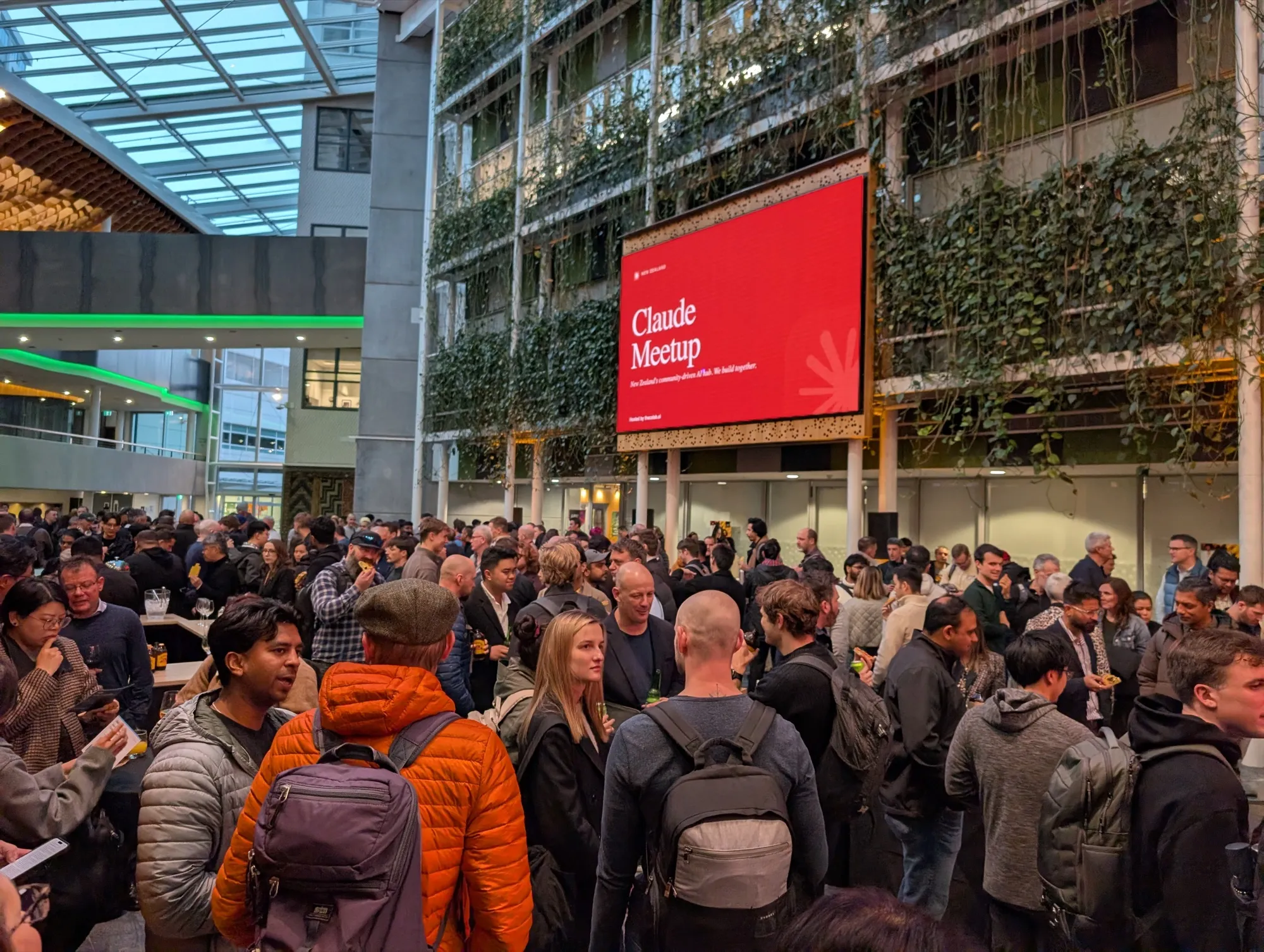
Notes and takeaways from the Claude Meetup Aotearoa, September 2026
Notes from the September Claude meetup at AUT: rebuilding an agency around AI, what AWS sees between pilot and production, live artifacts, a solo-built op shop platform, AUT's own multi-model GPT, and a personal story about AI at a hospital bedside. With commentary from the ElementX crew.
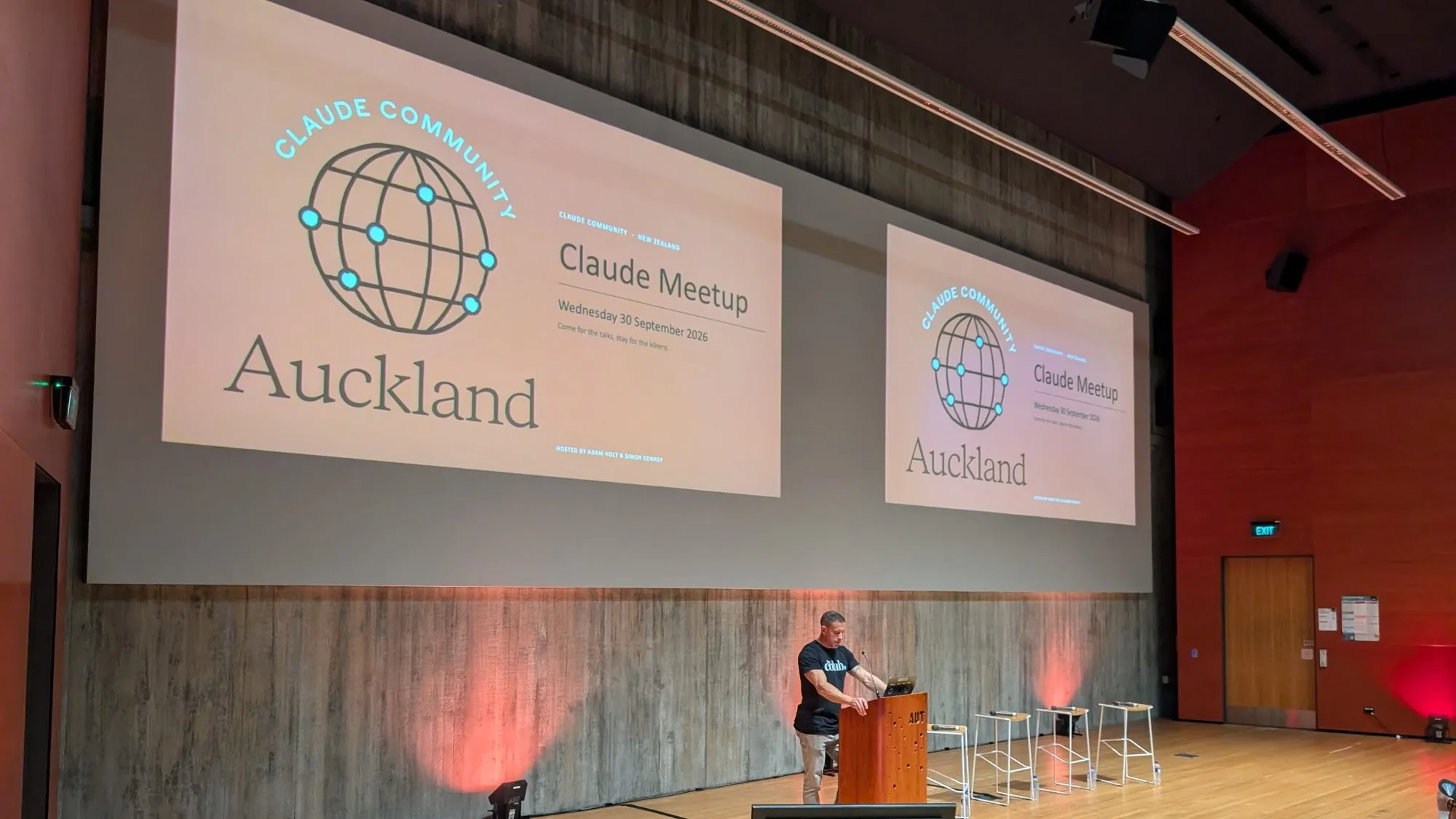
The September Claude meetup was held at AUT in Auckland on 30 September 2026, sponsored by AWS, with Simon Conroy of CoLab as MC. Overdose’s group CEO Paul Pritchard and AWS’s head of AI in New Zealand, Matthew Haigh, gave the keynotes, followed by four show and tells from the community.
These are our notes for anyone who couldn’t make it or wants the takeaways in one place, with our own commentary throughout in the “Our take” blocks.
The short version
These are the threads that ran through the Claude Meetup Aotearoa at AUT in Auckland on 30 September 2026, with links to the talks behind them.
- AI is now a daily habit. 94% of people who registered for the meetup use AI every day, up from 30% at the community’s first meetup in December 2025, and more than half don’t build software for a living. Who was in the room.
- Power users are not institutional capability. “If it only lives on our best people’s laptops, it’s still a hobby,” said Overdose group CEO Paul Pritchard. What individuals learn leaves with them unless it becomes shared context and skills. Paul Pritchard.
- Retrieval is not intelligence. After six months on enterprise search, Overdose built a company brain it owns: plain markdown in Google Drive, skills in GitHub and Claude as the interface. Paul Pritchard.
- Budget tokens as cost of goods. Overdose used up an annual Anthropic spend commitment long before the year was out, so it now prices tokens alongside delivery costs rather than on the software line. Paul Pritchard.
- Judgement fades if all you do is approve. Paul Pritchard wants approvals to be active, with people interrogating AI output before they sign it off, and AWS’s Matthew Haigh warned that “the approval is meaningless when people have not actually engaged in the overall questions and evidence.” Paul Pritchard and Matthew Haigh.
- Evals and model approvals are the real bottlenecks to production. Matthew Haigh, head of AI at AWS New Zealand, said evaluations are what let you sign off an update and switch models as new ones arrive, and urged organisations to plan for the fiftieth agent from day one. Matthew Haigh.
- Anyone can now build and share live tools, and one person can take a product to market. Adam Holt showed a live guest board for the meetup built as a Claude artifact, and Claire Byrne took her op shop app, Op Spot, from idea to app store in three weeks without a development team. Adam Holt and Claire Byrne.
- One tool doesn’t fit a whole university. AUT built AUT GPT on open-source tools to give its 4,000 staff a choice of AI models, with the platform deciding where each prompt’s data can go. Abby Dowd and Asher Finlayson.
- AI helps people make sense of an unfamiliar field, including at the hardest moments of their lives. Klaus Bravenboer built a system and a narrated 3D digital twin to help his best friend’s family understand the treatment and bring better questions to the doctors. Klaus Bravenboer.
How the conversation has moved since July
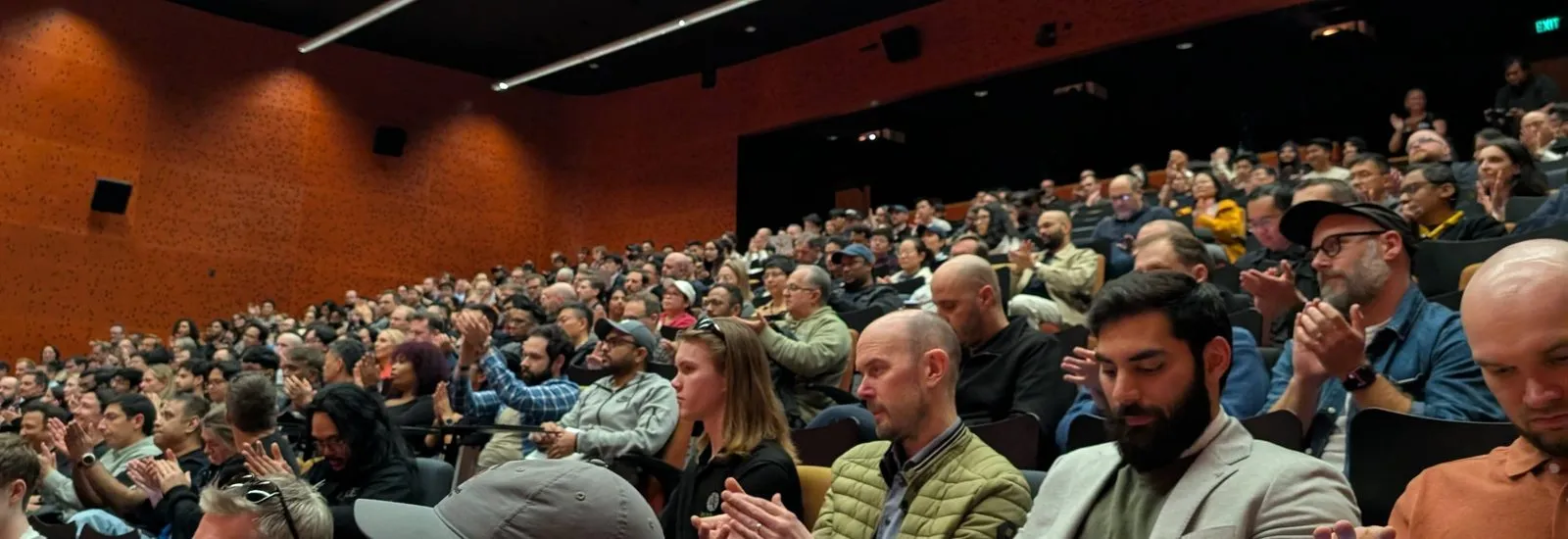
At the July meetup, much of the talk was still about getting people to use AI at all. Three months later, with 94% of registrants using it daily, nobody on stage was arguing for adoption. The questions had moved on to what an organisation keeps when individuals get good at AI, what it costs once usage is real, what it takes to put an agent in front of customers, and what happens to people’s judgement once the machine does most of the doing. It’s the gap between personal and functional productivity that the Aotearoa AI Summit kept returning to, and this time we heard from people on the far side of it.
Who was in the room, and how it has changed since December
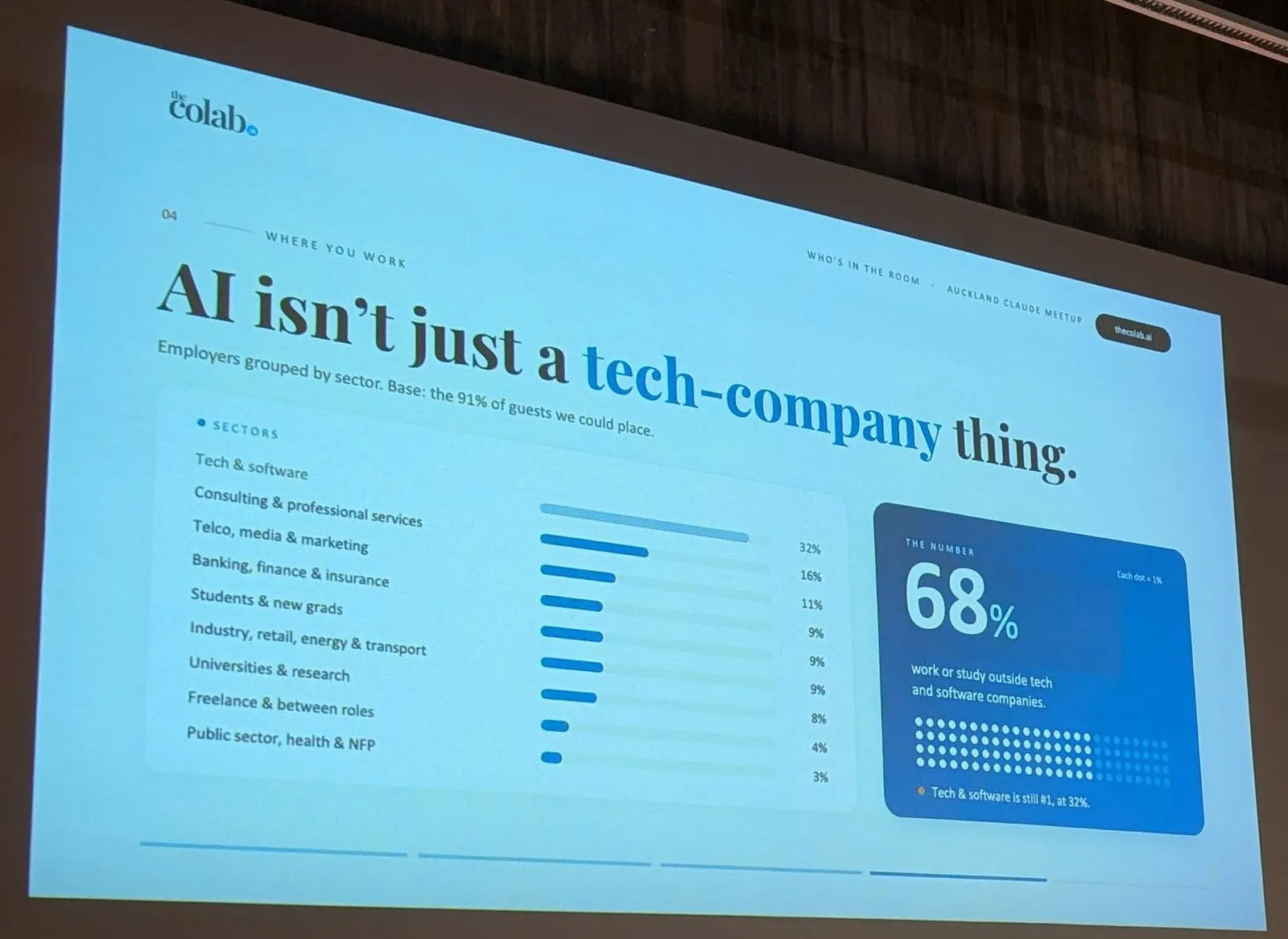
Simon opened with a snapshot of the audience from the registration survey, set against the community’s first meetup last December.
- 94% use AI every day, up from 30% in December, and only 2% use it weekly or less.
- More than half don’t build software for a living. 47% work in engineering, AI and data, or product and design, down from 61% in December. Tech is still the biggest single sector at 32%, down from 51%, and over two-thirds now work or study outside tech and software companies: consultancies, telcos, media, banks, insurers, retail, universities and the public sector.
- Leaders are hands-on. 44% lead a team, a function or a company, and 9% now have AI in their job title, roughly double nine months ago.
- AI is a team sport. 18% came with four or more colleagues, up from 3% in December.
Paul Pritchard: rebuilding an agency around AI rather than adding it
Paul is group CEO of Overdose, a commerce agency with teams across London, Melbourne, Sydney, Brisbane and Singapore. In June 2025 he told the whole company the business was changing permanently. Overdose was busy and profitable, and “it felt like it was the dumbest time” to pull it apart, though it was probably the only time it could.
“We didn’t adopt AI; we rebuilt the business around it.”
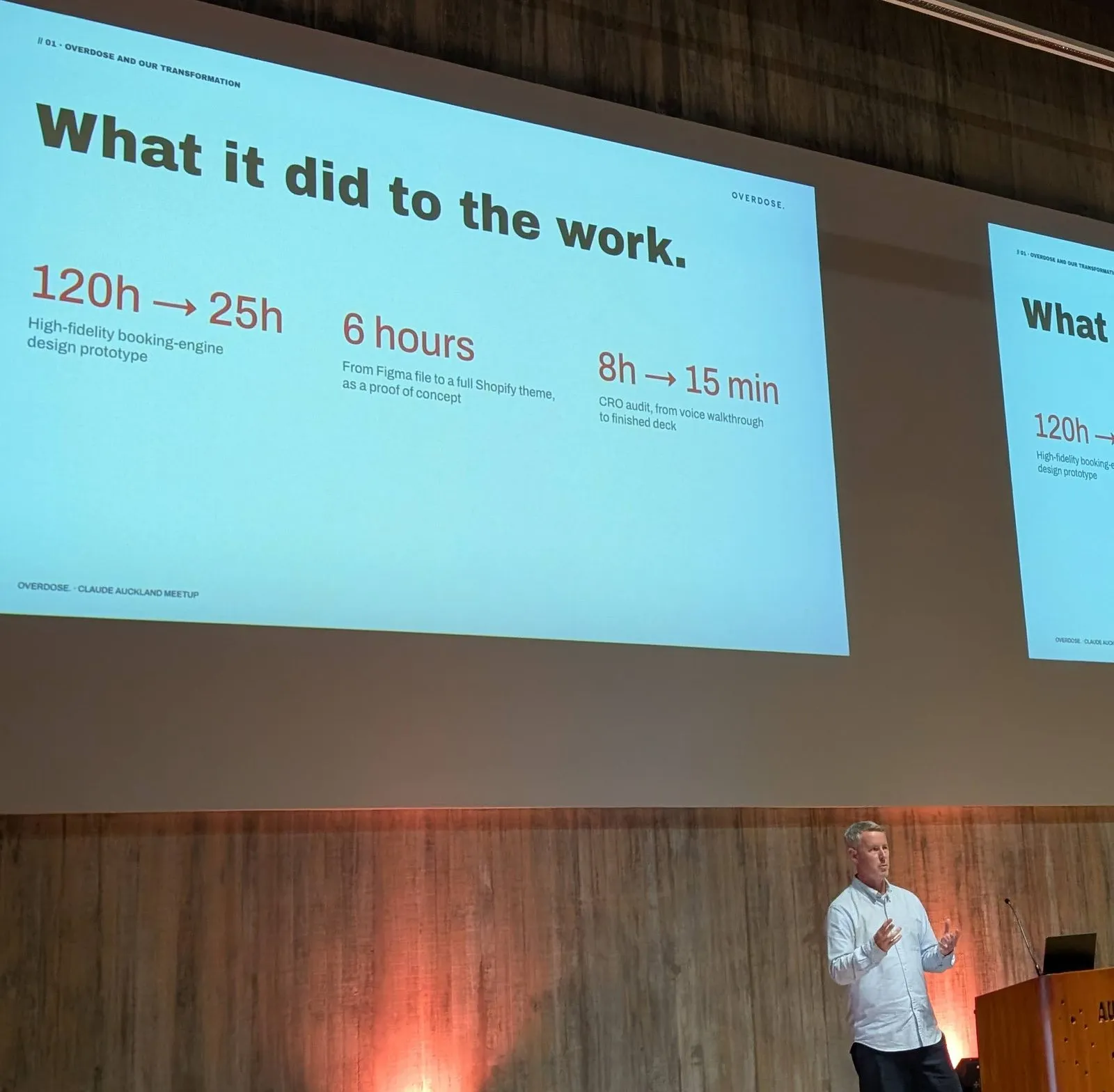
- Speed alone doesn’t change the business. A high-fidelity design prototype for a booking engine went from 120 hours to 25, a Figma design became a working Shopify theme in six hours as a proof of concept, and a conversion audit, from voice walkthrough to finished deck, went from eight hours to fifteen minutes. Paul’s point is that this only makes the existing business faster.
- If it only lives on your best people’s laptops, it’s a hobby. Overdose started with plenty of ChatGPT accounts that made individuals faster and sharper, and none of it changed the business. When those people left, the knowledge went with them.
- Retrieval is not intelligence. Overdose spent six months on enterprise search (Glean), which told people what existed but couldn’t build on what everyone else was doing. What it needed was a brain the business owns: plain markdown in Google Drive, skills in GitHub, and Claude as the interface, portable by design in case Claude stops being the right tool. When someone finds a better way to run an audit or write a proposal, it becomes a skill, and the next person starts from there.
- “We’re only ever as good as the resisters in our business.” Alongside strict governance over what goes into the brain, adoption was the biggest challenge. Every person gets a path, in their own way, with an expectation that they walk it. People who got good at AI in isolation produced great work nobody else saw or reused.
- Enable one team at a time. More licences and training days don’t fix a team with two super users and everyone else treating AI as “a big orange box”. Shared context, skills and workflows do. Overdose started with marketing, closest to the customer and easiest to measure, and each team since has started from what the last one built.
- Tokens are cost of goods. Earlier this year Paul signed an annual Anthropic spend commitment that terrified him, and Overdose used it up long before the year was out. Even so, it’s a fraction of the cost of the people it would take to do the same work, and it hasn’t replaced anyone. Budget it on the software line and you’ll get a surprise, so Overdose prices it as a cost that scales with the work, and coaches people to get a good result in fewer attempts.
- Security needs an owner. A brain holding your people, clients and financials is powerful, and an agent never sleeps. Overdose uses a three-tier classification that sets what each agent and role can see, keeps a human on anything touching customers, money or people, and is hiring a dedicated team, since IT and HR each treat it as someone else’s priority and policies get read once and filed.
- AI changes the job more than it takes it. What’s left when AI does the doing is framing the problem, knowing what good looks like, applying judgement and being responsible. “You can’t send AI to jail.” Overdose’s engineers have moved from operators to orchestrators, and every job description is being rewritten.
- Protect judgement from atrophy. Airlines make pilots hand-fly part of every flight because it’s a skill they can’t afford to lose, and approving AI output all day erodes the skill that made you a good judge. Paul’s three measures: keep a hand on the work, make approvals active by interrogating the output, and train people to stand behind their work and explain the intent behind it. “We can’t know what good looks like if we stop making it.”
Matthew Haigh: what AWS sees between pilot and production
Matthew is head of AI at AWS in New Zealand, and used his talk to reflect back what he sees across local teams.
- Where the conversations are. Engineering enablement, knowledge worker enablement and, where he spends most of his time, business workflows and digital products. “Data and AI” has become “data for AI”, mostly semantic models that agents can consume, and security conversations have picked up sharply in the last few months.
- What leading organisations do. A top-down mandate with curated use cases, governance owned by the people building the tools, an operating model built on accountability, an open data and AI platform, and champion networks to drive the change.
- Claude on AWS. Bedrock keeps Claude inside the AWS security boundary, with Australian inference, which is the usual choice for banks and telcos. The recent surge of interest is in a gateway for rolling Claude Code and the desktop apps out across an organisation from your own VPC, mostly for the spend limits.
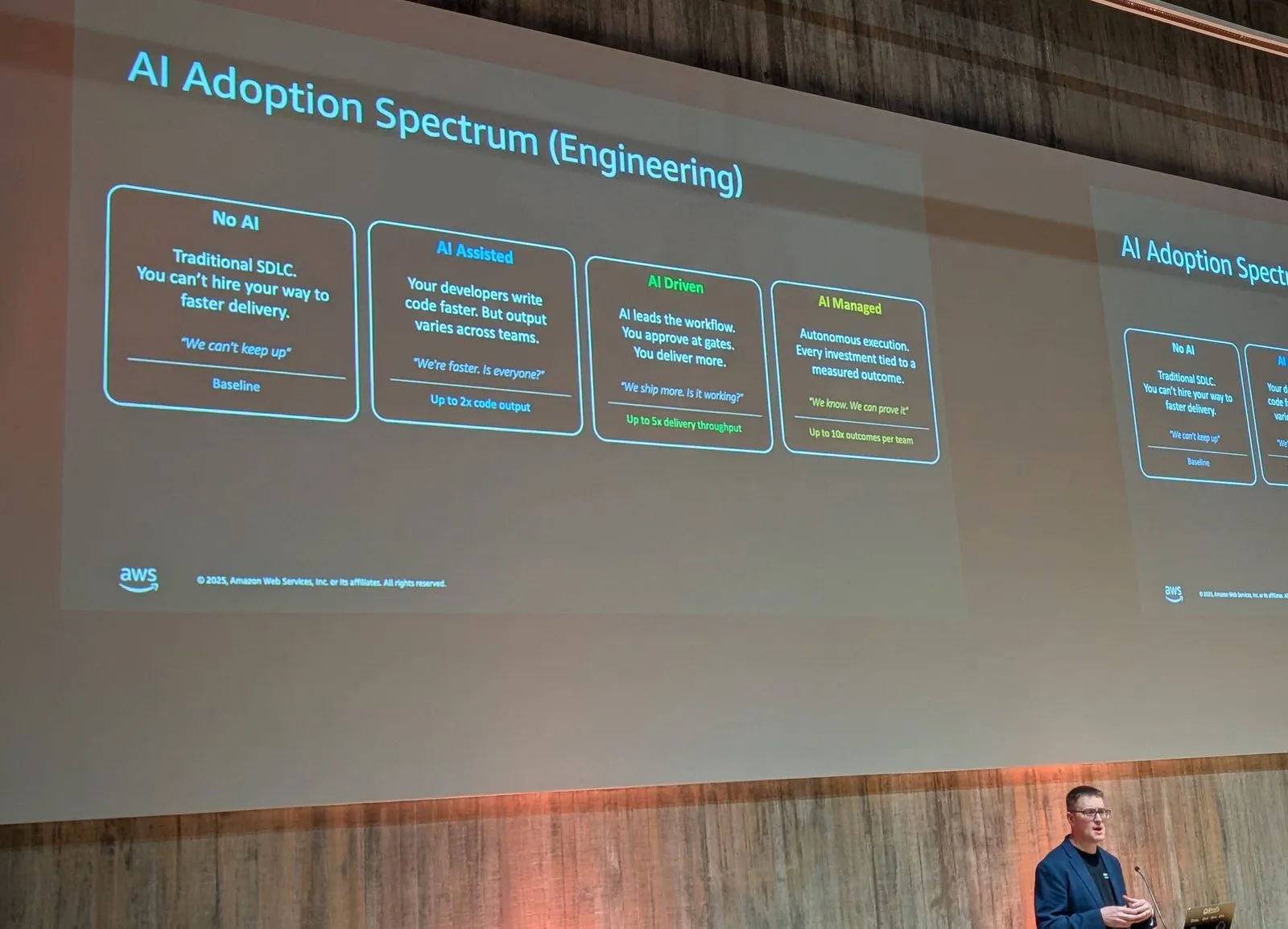
- The engineering adoption spectrum. Teams move from AI-assisted to AI-driven to AI-managed. The tools are here; moving up means restructuring the process, roles and ceremonies around them, which AWS calls the AI-driven development lifecycle (AI-DLC). At the AI-managed end, agents carry more of the load but “the approval is meaningless when people have not actually engaged in the overall questions and evidence.”
- What production agents need. Using Bedrock AgentCore as the example: an isolated runtime spun up per session and destroyed afterwards, memory, an MCP gateway to internal systems, identity that holds from the user through the app and agent to the tool, observability, and codified business policies that stop an agent doing something like issuing an unauthorised refund.
- The bottlenecks. Model approvals, which got a slide with nothing on it but its title: start talking to risk and compliance now, and decide early who owns each agent. Boilerplate, since every team building its own harness is “a world of pain that takes away the joy of building an agent”. Most of all evaluations, which are what let you sign off an update, confirm it performs against your ground truth before it reaches your call centre, and switch models as new ones arrive.
- Plan for the fiftieth agent. Matthew is working with about nine customers restructuring around an agentic platform, much as organisations once built MLOps teams, so that the forty-ninth and fiftieth agents are as easy to deploy as the tenth.
Adam Holt: live artifacts anyone can build and share
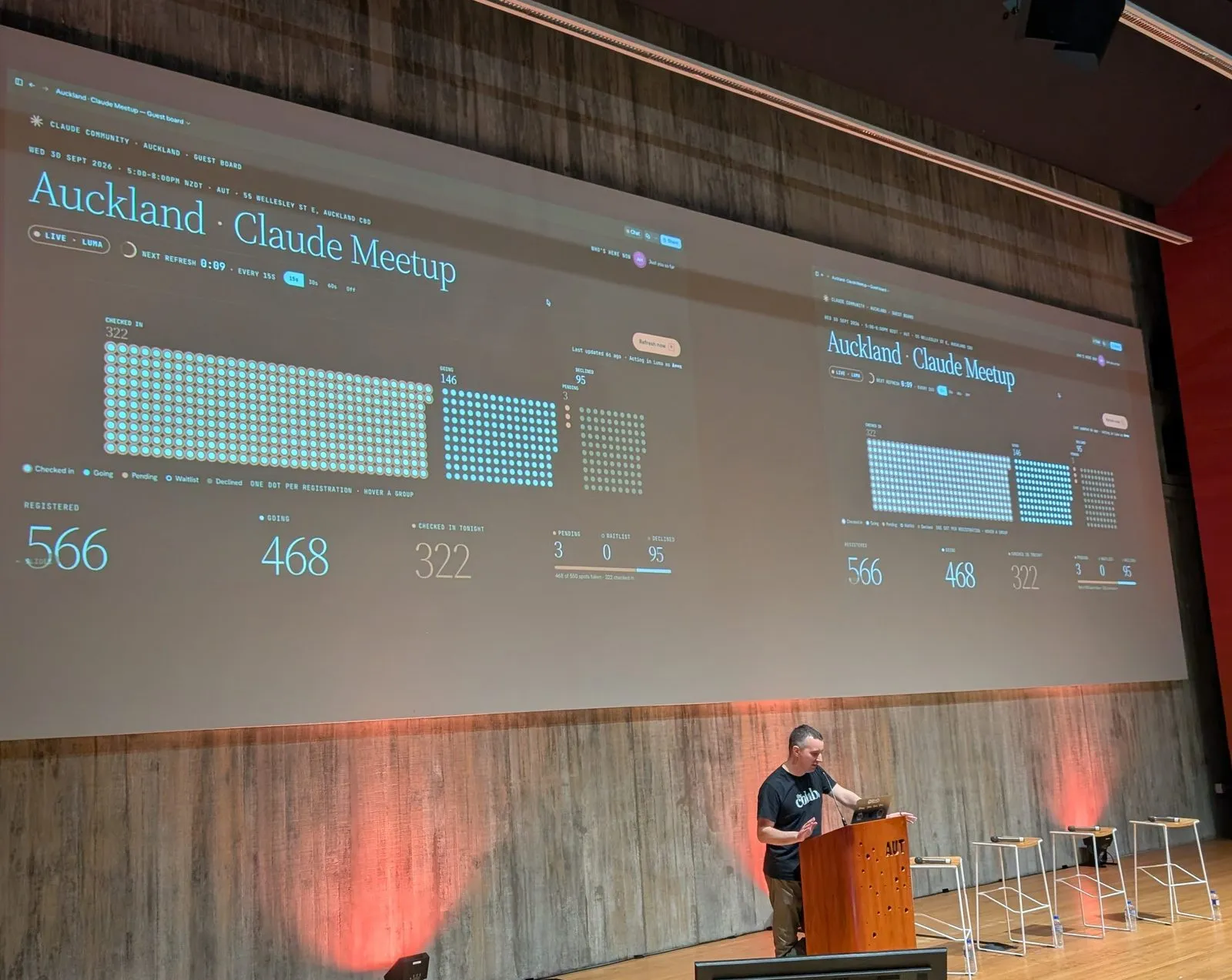
Adam, New Zealand’s Claude Ambassador and Simon’s business partner at CoLab, gave his lightning talk as an artifact.
- Claude made the explainer video. Using Opus 5.5, it read the documentation, wrote the script, used ElevenLabs for music and narration, and built the video in HTML, CSS and JavaScript.
- Live data, with each viewer’s own permissions. An artifact is anything Claude makes that you put in front of someone, at a private link on claude.ai. Through MCP connectors it pulls today’s data from systems like Shopify, Xero, Snowflake or HubSpot and can post messages or update records. Every call runs through the viewer’s own account, so two people opening the same page each see only what they can access, and the page never sees anyone’s credentials.
- Claude inside the page. Viewers can ask questions of the data in front of them, on their own plan, with no API key.
- Private by default. On Team and Enterprise plans you share inside your organisation, and pages that use connectors or Claude never go on a public link.
- The guest list, live. In the demo video, the page showed 524 registrations with 423 approved, where the spreadsheet export said 426. It kept counting on the night: by the time Adam spoke it showed 566 registrations and 322 people checked in, and it could answer which industries were in the room. A multiplayer, real-time tool across several data sources used to be a substantial project.
Claire Byrne: taking an op shop app to market without a development team
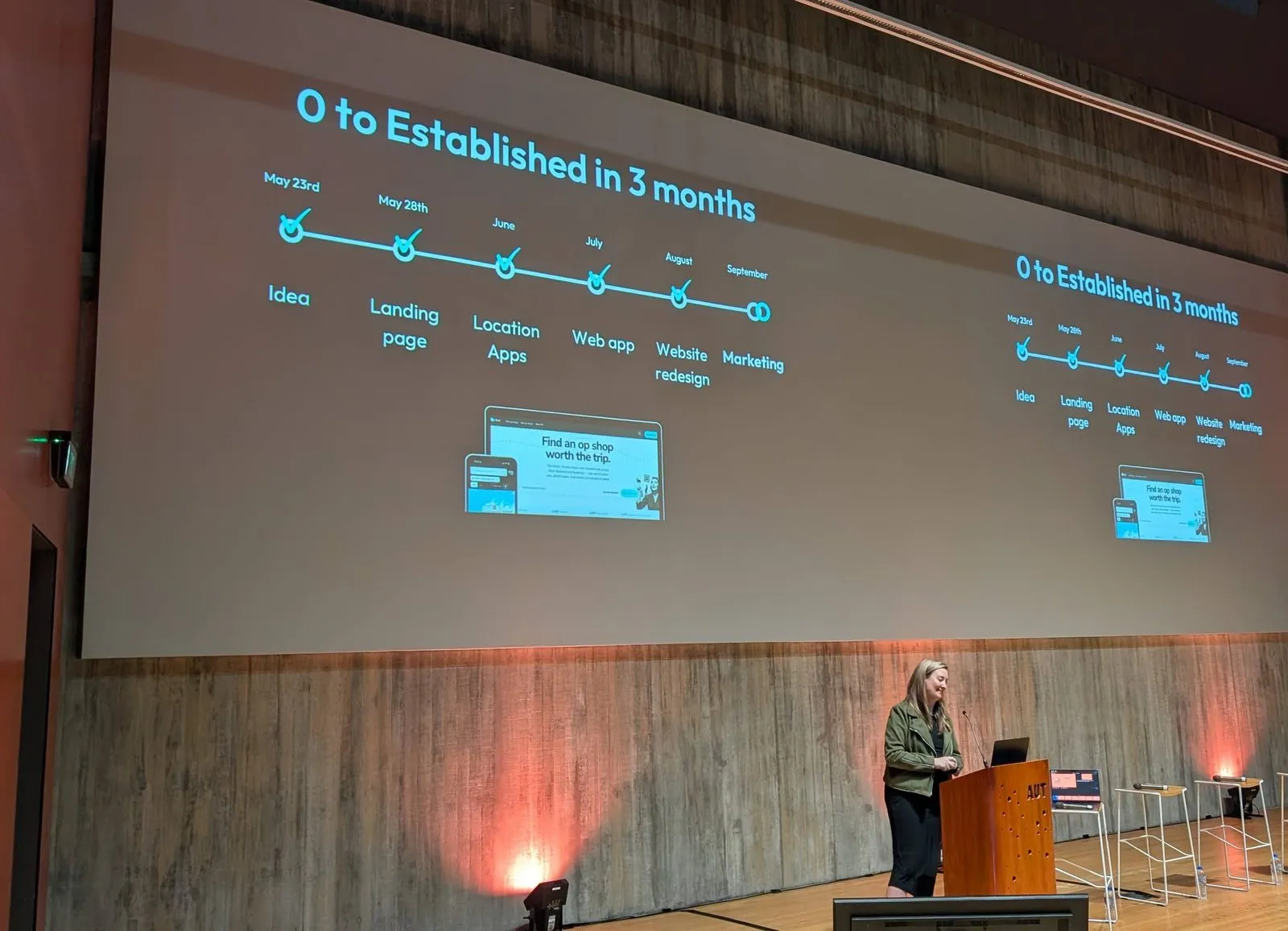
Claire is an AI enablement coach who had tested every year whether she could build something real on her own. For a long time the answer was no; Claude 3.7 was the turning point.
- Idea to app store in three weeks. After running a hackathon in her day job, she built Op Spot, an app for finding the nearest op shop, with the Android app and website following within weeks.
- Four months on, it’s robust software. Measured in GitHub commits, it’s the equivalent of eight years of development work, built with Claude and Codex.
- The hard work started after launch. Talking to users showed that finding the nearest op shop is a niche behaviour, so she opened the data up as a website search engines can index, which has had nearly half a million impressions on Google and AI search. Testing posts in local Facebook groups showed the most popular thing was a printable checklist of nearby op shops.
- The mission came last. She moved so fast that when she was asked to introduce the platform at the op shop summit in August, she didn’t have a mission statement. She does now: to make shopping second-hand your first choice, which widens the work to a data set on the sector, a donation map, and resources that help op shops lift their digital skills.
- Go deep on the thing that keeps you up at night. Her advice was to pick a problem you care about and have expertise in. She funds the tokens and hosting herself, and would welcome sponsors and volunteers.
Abby Dowd and Asher Finlayson: giving 4,000 AUT staff a choice of AI
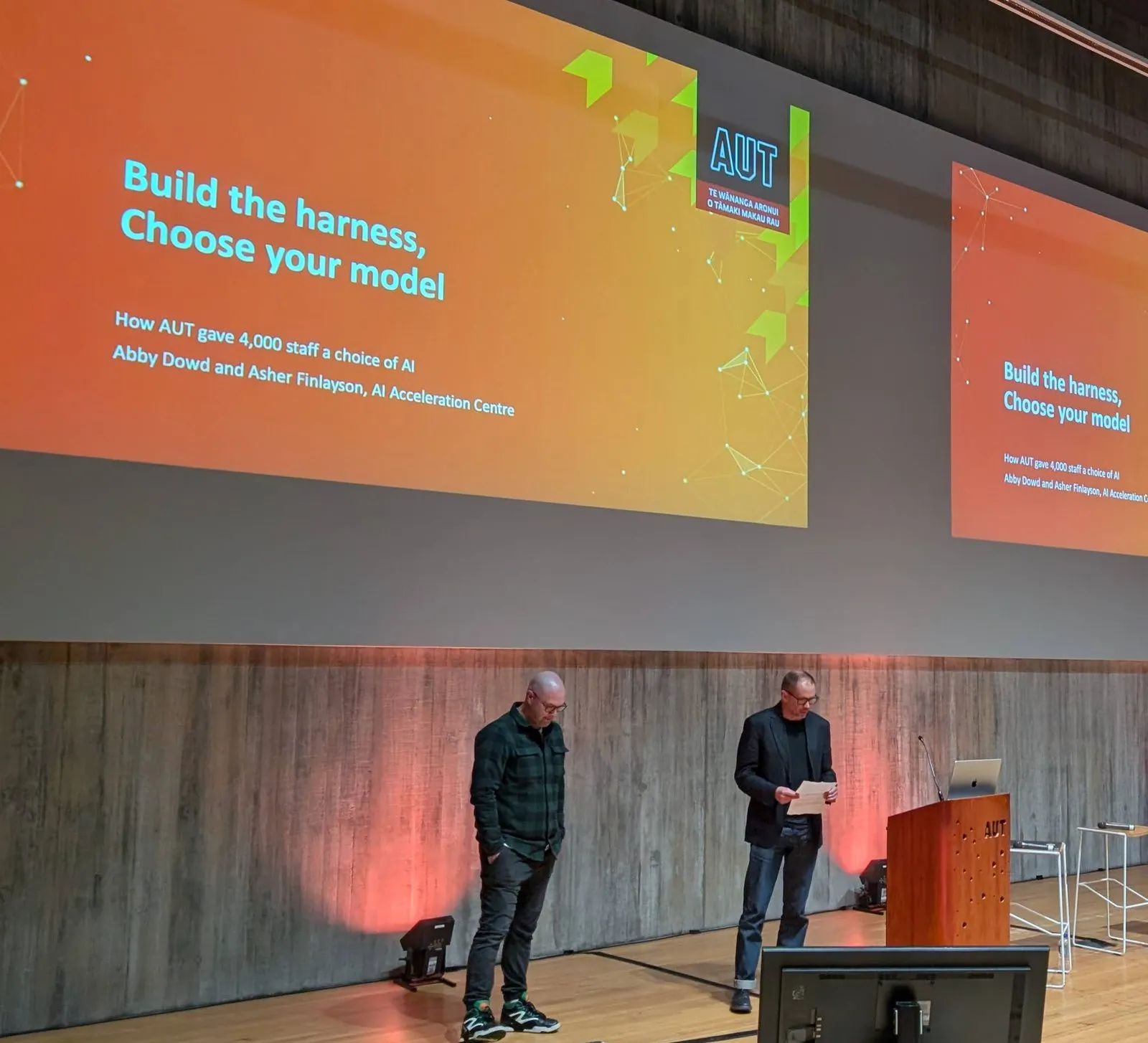
Abby and Asher work in AUT’s AI Acceleration Centre, helping the university adopt AI, and demoed AUT GPT, the university-hosted AI platform for its 4,000 staff.
- Why a university has to get this right. Students starting this year will be job hunting in three years, so staff need to be capable, thoughtful users who keep what students learn relevant. AUT’s AI strategy commits to enablement over restriction, in line with its principles on privacy and Māori data sovereignty.
- Why build rather than buy. Some staff were using free tools, some paid for their own, and many didn’t engage at all. Copilot wasn’t hitting the mark, and a premium subscription for everyone would cost more than AUT could justify and lock staff into one vendor. AUT GPT is built on open-source tools (Open WebUI, LiteLLM and Langfuse), runs on AUT servers and gives staff a choice of Claude, ChatGPT, Gemini, Grok, DeepSeek and a locally hosted Qwen.
- Many models side by side. Asher sent one prompt to Claude, ChatGPT and Gemini at once, merged the three answers, then asked Claude alone to critique the result as a sceptical university CIO, all in the same window.
- Teaching non-determinism with a car wash. His favourite workshop prompt: “I need to go to the car wash. It’s 50 metres away. Should I walk or should I drive?” Models regularly say walk, forgetting the car has to come too. In a few seconds, staff see that models are non-deterministic, differ from each other, and can hallucinate.
- Trust tiers, enforced by the platform. AUT’s IT team rates AI tools across five trust levels. Used directly, Claude, ChatGPT and Gemini only get basic internal documents, and DeepSeek isn’t permitted at all. Through AUT GPT, the university controls where each prompt goes, whether to the provider, its Azure tenancy or a local model, instead of relying on every staff member to remember what not to share.
Klaus Bravenboer: making sense of a friend’s cancer treatment
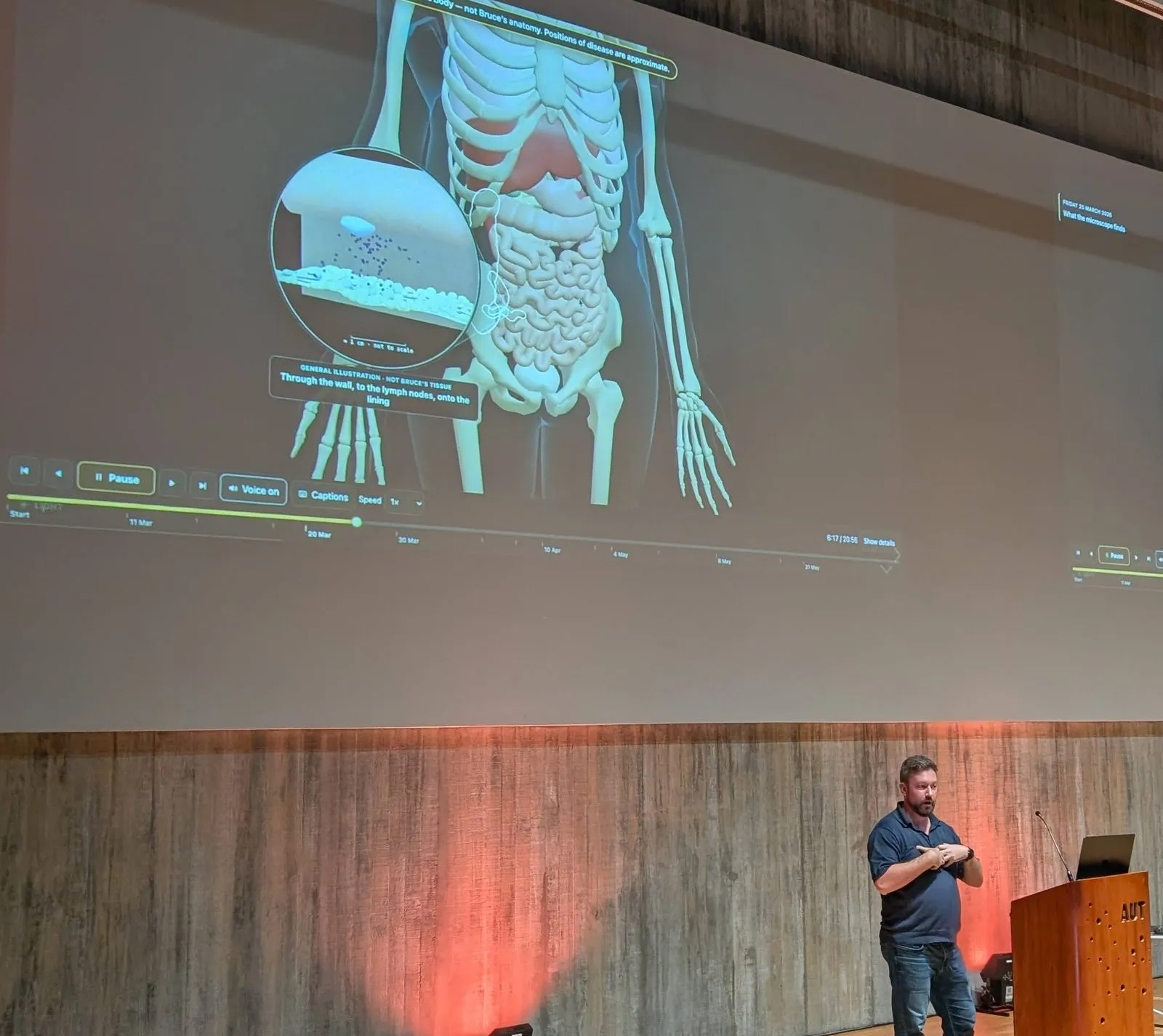
The final show and tell was a personal one. With the blessing of the family, Klaus told the story of his best friend’s diagnosis with appendix cancer.
- Overwhelm, at the moment decisions matter most. A diagnosis brings shock and a flood of unfamiliar jargon, while the family had to make fast, consequential decisions every day with information scattered across hospitals in New Zealand and overseas.
- Bringing it all into one place. Working from a laptop beside the hospital bed, Klaus built a system that ingested everything: an evidence ledger of 563 items, from PDFs and scans to recordings of doctors’ explanations (taken with their permission), a timeline of what happened where, and a way to ask questions grounded in all of it.
- A digital twin to learn from. Klaus turned the records into a narrated 3D model, built on a reference body, that walks through each scan and report in date order. You can pause it, move around and click any unfamiliar term to have it explained, so the family could teach themselves the language they were hearing from doctors.
- Better questions for the medical team. The decisions stayed with his friend’s doctors; the system helped the family understand what they were hearing and ask good questions. When a scan required a contrast drink that would have made his friend vomit, it surfaced that other countries give it intravenously; the family raised it, and the medical team changed the plan. When pain relief was causing nightmares, the evidence helped the family explain the problem to the doctors, who found a different drug at a lower dose.
- Agents that kept working so he could be present. Moving to agents running in the cloud meant the work carried on while Klaus sat with his friend, held his hand and talked through what mattered.
- No stone unturned. At the funeral, his friend’s wife said it let the family keep asking questions and researching possibilities to the end, with the peace of mind that they had left no stone unturned.
We help organisations turn individual AI use into institutional capability
-
Talk to us
If any of these talks raised questions for your organisation, a 30-minute call is the quickest way to work through them.
-
The Agent-Native Blueprint
Your people are already using AI one by one. The Blueprint takes it across the whole organisation: shared context, secure access, and governance.
-
Agentic infrastructure
The runtime, identity, gateways and evals that let an enterprise put its fiftieth agent into production as safely as its first.